

The Dangerous Question "Am I Depressed?", And What to Ask Instead
The Question That Sounds Responsible, But Isn't
3am. The ceiling stares back at you. Your chest is heavy. And the question slips out, "Am I depressed?"
You've whispered it in the shower. Typed it into Google at midnight. Maybe even said it out loud to a partner who looked back with that mix of worry and confusion.
It feels like the right question. Self-aware. Responsible. Proactive.
Here's what almost nobody tells you: that question can quietly steer you down a path that keeps you stuck longer than it needs to be.
Not because it's wrong to ask. But because of where it leads you next.
It leads you to a label. And once that label sticks, it can quietly become your identity.
KEY TAKEAWAYS
Asking 'Am I depressed?' sends you hunting for a label, and labels can quietly become identities that are hard to shake.
Depression is a symptom of unresolved emotional wounds, not a broken brain, not a permanent identity.
Research links childhood emotional wounds to significantly higher rates of adult depression (odds ratio of 2.78 for emotional abuse).
The better questions shift focus from 'What's wrong with me?' to 'What happened to me? And how can I heal it?'
When the root cause is addressed, the catalyst of depression, and not just the symptoms, lasting relief is possible, often within a small number of sessions.
The Pain You're Feeling Is Real
Before going further, let me be clear, the symptoms that made you ask that question are real. They're not a sign of weakness. They're not in your head. And they deserve to be taken seriously.
At Zest Quest, the same descriptions come up every week:
A heaviness in your body that makes getting out of bed feel like lifting weights
Brain fog so thick that simple decisions feel impossible
Emotions that are either completely numb or overwhelming
Joy, excitement, and basic contentment have gone flat
Everything feels exhausting, even things you used to love
Relationships start to strain because you're withdrawing, snapping, or just not there
According to Beyond Blue, depression affects around 1 in 7 Australians at some point in their lives. That's your colleague who seems fine on Zoom, the parent at school drop-off who's smiling through it, or the mate who stopped replying to messages.
Those symptoms are real. They can meet the clinical criteria for depression.
But here's the crucial difference: depression is not the problem. It's the symptom.
It's the result of unaddressed and accumulated emotional wounding and stress that has built up over years, often with coping patterns that once helped you get through, but now keep you stuck. Stuck wondering what’s the diagnosis and what do I do wrong.
Why 'Am I Depressed?' Is the Wrong Starting Point
When that heavy, numb, exhausted feeling settles in, it's natural to want an explanation. You search online and suddenly you're staring at symptom checklists and 90-second quizzes promising to tell you 'yes or no.'
On the surface, it looks helpful. You're being proactive. Seeking understanding.
What actually happens is this: you start looking for a classification. A neat little box that says 'This is what's wrong with me.'
And once you find one, whether from a quiz, a friend's story, or even a professional diagnosis, you stop asking the deeper questions:
Why do I feel this way?
When did I start down this path?
What happened to me over time?
What am I carrying that I've never been allowed to put down?
The question 'Am I depressed?' quietly becomes 'I am depressed.' That shift, from a temporary experience to a permanent identity, is where the real danger begins.
"I am depressed" is a very different sentence from "I am experiencing depression." One is a state. The other becomes a story.
Three Common Types of People Stuck in Depression. Which One Are You?
After years of working with clients, a clear pattern has emerged. Three common ways people get stuck, although there are other types, these occur often. See if any of these feel familiar:
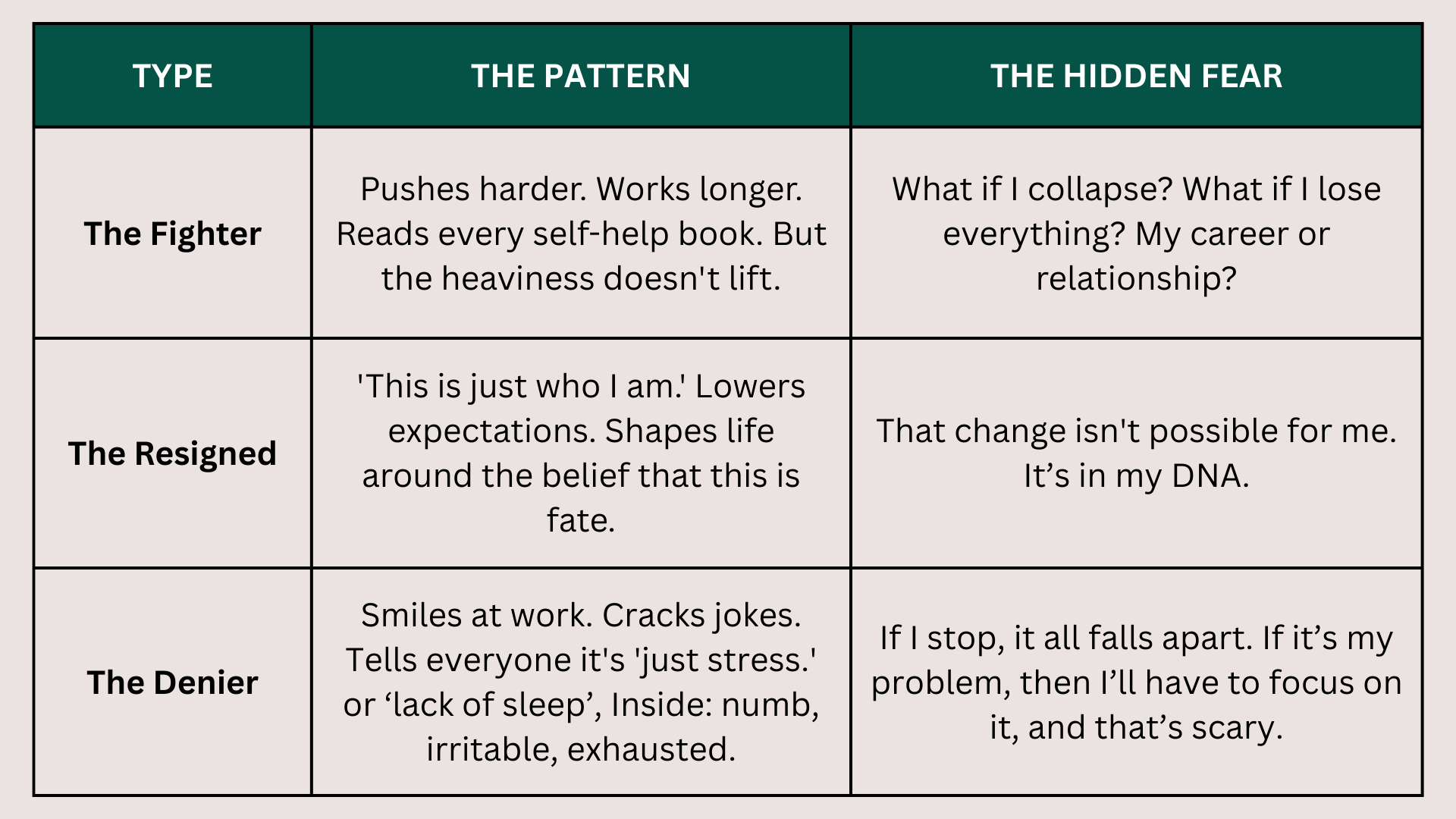
None of these are wrong. In fact, whilst there is often a predominant type, many people in depression cycle through all of these. They're survival mechanisms. Smart adaptations built over years.
The problem is they all avoid the real question: What were my experiences for me to end up here?
What's Actually Creating the Depression
This is the part that changes everything.
Depression doesn't have to be a life sentence or a broken brain that needs managing forever. At Zest Quest, it's seen as the body and mind saying: 'I've been carrying too much for too long, and I don't have the tools or safety to process it.'
That 'too much' almost always traces back to emotional wounds:
Feeling unseen or unimportant as a child
A critical parent who made you believe you were never enough
Having to be 'the strong one' or parent your own parents
Hot-and-cold caregiving that left you unable to trust yourself or others
Betrayal, loss, abuse, or simply never being allowed to feel your feelings fully
When those wounds aren't processed, coping strategies develop, pushing anger down, numbing out, becoming a workaholic, scrolling endlessly, drinking, gaming. Whatever keeps the pain at bay.
Over time, resilience chips away. Parts of you start shutting down to protect you from feeling miserable and not in control. The result? The exact symptoms that get labelled as depression.
What the Research Says
This isn't just lived experience. The research consistently backs it up.
A 2015 study by Mandelli, Petrelli, & Serretti recognised the role of specific early trauma in adult depression. Studies show that people with histories of childhood emotional abuse, neglect, or multiple traumas have significantly higher rates of depression in adulthood. The odds of becoming clinically depressed are 2.78 times greater for people who experienced childhood emotional abuse.
It’s important to note that many times a child’s experience of emotional discourse are simply that child’s experience, and often the interactions occur inadvertently from loving caregivers. This is not to point blame, but rather to recognise origins of repressed pain.
What that means in plain language: unresolved emotional wounds from the past are one of the strongest predictors of depression as an adult.
You're not weak. You're not broken. Your system did exactly what it was designed to do: survive. Now it's time to do something more than survive.
The Questions That Actually Lead to Freedom
So if 'Am I depressed?' is the dangerous question, what should be asked instead?
Try these:
What did I have to suppress to feel safe growing up?
Whose role was it to nurture me that didn't happen in a healthy way?
What beliefs did I form about myself that I'm still carrying?
What coping strategies that once protected me are now costing me my life?
These questions shift the focus from managing depression to understanding and healing the source of unhealthy beliefs and behaviour patterns.
That's a completely different destination.
"What's wrong with me?" is a dead-end. "What happened to me and how can I heal it?" is a doorway.
What Unhealed Wounds Do to Your Relationships
Depression doesn't just affect you. It ripples outward.
Partners feel you've 'changed' or aren't present. Kids sense the emotional distance. Friends stop inviting you because you've said no too many times.
The internal narrative starts: 'Maybe they'd be better off without me.' 'No one understands anyway.'
The craving for connection and nurturing is real. Many clients describe just wanting to be held and told everything will be okay, regardless of their age. The walls go up, and the very connection they need becomes harder to reach.
Healing the emotional wounds doesn't just lift the fog. It rebuilds the capacity to show up fully in relationships sometimes for the first time in years.
How the Healing Actually Works
At Zest Quest, the approach goes deeper than symptom management.
Using a unique combination of trauma-informed methods, including The Richards Trauma Process (TRTP) along with subconscious work and personalised coaching, the work targets the emotional wounds at their source. No reliving every painful detail. No years of weekly sessions picking through the past.
TRTP is a rapid trauma resolution process. Most clients experience significant, lasting shifts within a small number of sessions because the work goes directly to the subconscious, where the patterns actually live.
The results clients describe after doing this work:
Energy returns, not the kind that comes from forcing yourself, but genuine, natural vitality
Mental clarity replaces the fog
Relationships improve as emotional walls come down
Joy stops feeling like a distant memory
Purpose and opportunity for the future reveal themselves
A sense of self returns, often more authentic than before
Nicholas works with clients across Australia, the USA, and UK via Zoom, as well as in-person in Brisbane.
Depression is a symptom. Not your identity. And symptoms, when the emotional wounds are addressed, dissipate.
You're Not Broken, and This Is Not a Life Sentence
Everything you've done to cope, the pushing, the numbing, the denial, the fighting, all made perfect sense at the time. You were surviving with the tools available.
You don't have to keep just surviving.
I’ve walked this road personally, through deep depression, rock bottom, and out the other side. Not by managing symptoms, but by healing the wounds underneath. Clients at Zest Quest have done the same. They've reclaimed their energy, their relationships, their careers, and their sense of self. And beautifully, some have embarked on positive new directions and truly living on purpose.
That path is available to you too.
The Next Step
If the heaviness, the fog, the disconnection feel familiar...
If you're done accepting 'this is just how I am'...
If you're ready to understand what's actually been driving this, and finally release it...
The next step is a free 45-minute Rapport Session. No obligation, no hard sell. Just an honest conversation about where you are and whether this approach feels right for you.
→ Book your free Rapport Session at zestquest.com.au