
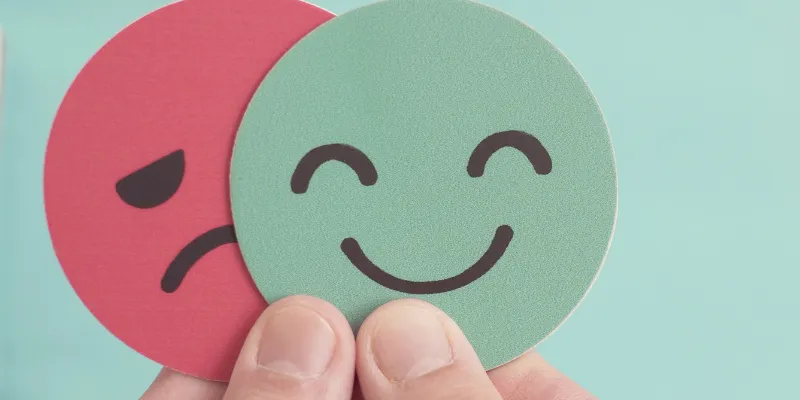
The Two Faces of Unhealthy Boundaries
Two Patterns. One Room.
Over the years, sitting with clients, a pattern becomes hard to miss.
Two very different kinds of people come through the door and on the surface, they look very different. One says yes to everything and can't understand why they're exhausted. The other handles everything alone and can't understand why they've become isolated and miss real relational connection.
What strikes me most is that these aren't simply contrasting problems. They're the same emotional wound of unhealthy boundaries, expressed in two different directions.
That's what this piece is about, looking at the two faces of unhealthy behaviour boundaries, the damaging impact of each and how to shift the dynamic to a enhance self-appreciation and the quality of your relationships.
These Behaviour Patterns Have A Purpose
The first thing worth saying is that boundary struggles aren't something you choose or defects in who you are. Almost everyone has tensions in at least some relationships some of the time, and what is hiding behind the tension is an expression of adverse behaviour boundary.
These behaviour patterns developed because you needed survival strategies. Created by your internal instinct, intuition and intelligent. At some point, usually long before adulthood, a person learned that the way they were moving through the world wasn't safe, pleasant and comfortable. From there beliefs were formed and a set of behaviours were created around it. That program in your operating system, though, has kept running, sometimes for decades and long after the original threat was gone.
Recognising that the strategies were developed for surviving your world when you were young is where the work begins. It is not by placing blame, or by feeling shame. But rather with honest clarity about what's happening and why you have them.

Face One: The People Pleaser
In the room, People Pleasers often describe the same thing in different words: a life lived for other people's comfort, with very little left over for their own.
The emotional door is always open and somewhere along the way, they stopped checking who was coming through it or what they wanted.
Some things that tend to show up:
Saying yes when every part of the body is screaming no
Feeling responsible for how everyone around them feels
Avoiding conflict, even when their own needs are being ignored
Doing things for others with quiet resentment baked in, and then feeling guilty about the resentment
A chronic, bone-deep exhaustion that doesn't make sense on paper
The pattern underneath this is called the fawn response. The fawn response was first named by therapist Pete Walker. Fawning is the fourth trauma response, alongside fight, flight, and freeze. Where fight confronts danger and flight escapes it, the fawn response tries to appease it. You become agreeable, you become useful and make yourself non-threatening which compromises your worth to keep the peace and avoid rejection.
For a child who grew up in a home where emotional safety depended on reading a parent's moods, keeping the peace, or making themselves small, fawning was an intelligent strategy. It worked, and it may have been the only thing that worked.
As an adult, that same strategy comes at a cost.
When fawning becomes the default, the sense of where you end and another person begins starts to dissolve. Notably, your own voice fades, your relationships start to feel one-sided and draining and you keep doing for others. Underneath your endless giving, your resentment and anxiety build quietly, and the exhaustion becomes something sleep can't fix.
Clinically, chronic people-pleasing is linked to burnout, identity diffusion, elevated cortisol, compromised immune function, muscular tension, and disrupted sleep. The body keeps the score that the mind has learned to ignore.
The People Pleaser isn't too kind. They're survival-motivated. That's an important distinction.
Face Two: The People Preventer
Unlike the People Pleaser profile, the People Preventer profile comes up far less in the wellness conversation. That invisibility is part of the problem and contributes to why these people feel detached.
The term People Preventer is one coined by Nicholas Dob here at Zest Quest to fill a real gap. Psychology and popular culture have been slow to name this pattern for what it actually is.
People Preventers have boundaries that are too rigid, too high, and too defended. The emotional door isn't just closed - it's bolted, barricaded, and the furniture has been moved in front of it.
What this looks like in practice:
A deep struggle to ask for help, even when it's definitely needed
Finding unsolicited support from others uncomfortable or even threatening
Keeping people at arm's length emotionally, including people held close
A strong preference for handling everything alone, almost as a matter of principle
Being told by those closest to them: "You're hard to know"
The psychological pattern underneath this is called hyper-independence.
Hyper-independence is a trauma response typically rooted in the freeze or flight response to chronic threat. At some point, trusting someone led to being hurt, overwhelmed, controlled, or abandoned, as well as combinations of these. The nervous system made a quiet declaration: I cannot trust anyone and I’ll never need anyone again.
What makes this pattern particularly hard to reach is that culture often rewards it. These people are seen as self-reliant, never asking for anything and has it all together. Those same qualities, though, become the masks that keep the self-worth wounds hidden and keep the person isolated inside their own competence.
What looks like strength from the outside is, on the inside, rigidity and a restriction to being themselves fully or getting the best out of relationships. Neither receiving all of the appreciation, affection and recognition they deserve, nor expressing emotions and sharing of their true self.
The cost is real: chronic loneliness, strained relationships, a creeping depression, and the painful paradox of craving connection while everything in the system pushes it away.
The Blueprint Written Before It Was Known
Whether the pattern leans toward people-pleasing or people-preventing, or swings between both, attachment style is almost always part of the picture.
Attachment theory tells us that early relational experiences with caregivers create an emotional blueprint. Before a child has language for any of it, questions get answered:
Is the world safe?
Are people reliable?
Am I worthy of love?
Three insecure attachment patterns are worth understanding here:
Anxious Attachment typically develops when caregivers were inconsistently available, loving sometimes, unavailable or distressing at others. The result is a nervous system permanently on high alert for signs of rejection and abandonment. Traits include chronic anxiety, difficulty feeling secure even in genuinely loving relationships, and being ready to do for others.
Avoidant Attachment often develops when caregivers were emotionally unavailable or responded to vulnerability with criticism, punishment (direct and indirect) or absence. The nervous system adapted by learning to switch off attachment needs entirely. Emotional self-sufficiency becomes armour and eventually, a prison.
Disorganised Attachment frequently arises when the caregiver was also a source of fear through abuse, unpredictability, or their own unresolved trauma. The result is a contradictory push-pull: a deep need for closeness combined with a fear of it. This can drive people-pleasing in one relationship and people-preventing in another or sometimes both with the same person.
These are patterns that formed in a specific context. When the context changes, and with the right support and genuine inner work, they can change too. That's not wishful thinking. It's what gets witnessed, consistently, in this work.
What Unhealthy Boundaries Are Actually Doing
The damage accumulates across every dimension of your life. This isn't a metaphor, but rather it's physiology and psychology working together.

Emotional
Chronic anxiety with a background hum that never quite turns off
Resentment that builds so slowly it starts to feel like a natural state
Loss of identity and growing confusion about what's actually wanted or valued
Emotional exhaustion that sleep doesn't fix
Depression, particularly for those running the rigid, avoidant pattern
Mental
Difficulty making decisions by either through constant deference to others, or through isolation that removes the relational feedback that helps calibrate judgment
Burnout and mental fog, which research consistently shows that poor boundaries in both directions significantly elevate the risk
'Quiet burnout' showing up, functioning, appearing fine, while running on empty inside and often feeling emotionally numb
For those with rigid patterns: all-or-nothing thinking, fear of failure, and a punishing inner critic that never takes a day off
Physical
The body keeps score. This is one of the most well-supported findings in contemporary trauma research (Bessel van der Kolk) and one that shows up clearly in client work.
Poor sleep is one of the most reliable early indicators of emotional dysregulation
Social isolation carries health risks equivalent to smoking 15 cigarettes a day (Holt-Lunstad et al., Brigham Young University)
Chronic loneliness is associated with a 50% increased risk of developing dementia, a 29% increased risk of heart disease, and a 32% increased risk of stroke (Holt-Lunstad, 2015)
Chronic people-pleasing is linked to elevated cortisol, suppressed immune function, gastrointestinal disturbances, and chronic pain
The World Health Organisation has declared loneliness a global public health crisis. The scale of harm is significant and measurable. And much of it traces back to patterns that formed long before the person sitting in front of me had any say in the matter.
What Healthy Boundaries Actually Look Like
Here's something that comes up again and again in sessions, and it's worth saying plainly. Healthy boundaries aren't the goal in themselves. They're the expression of a self that knows it has worth.
When someone knows, not just intellectually, but in their bones, that they are lovable simply because they exist, not because of what they do or how little they need, boundaries become natural. Healthy boundaries are not performances, are not walls, or weapons. They provide clarity and appropriate protection, benefiting yourself and those involved.
A healthy boundary:
Protects without punishing by saying 'this doesn't work for me' rather than 'you are the problem'
Communicates rather than conceals, as it involves a conversation, not a closed door
Is flexible, not rigid and adapts to context, relationship, and evolving trust
Moves toward connection, even when you’re uncomfortable. Its purpose is to make genuine closeness more possible, not less
Is rooted in self-knowledge and comes from knowing what's needed in order to stay well and whole. It is not driven from fear of being hurt again
The research on genuinely healthy boundaries is consistent: reduced burnout, better sleep, stronger relationships, lower anxiety, more authentic self-expression, and measurable gains in emotional resilience.
A Special Note For The Men Reading This
This section focusses on men and yet it matters to women and men. The importance is high, so it's worth being direct.
Australian research shows that men with stronger adherence to traditional masculinity beliefs, such as self-reliance, emotional stoicism, never asking for help, are significantly lonelier. Men account for approximately three in four suicide deaths in Australia, with an average of 7 male suicides per day (Australian Bureau of Statistics).
For many men, the People Preventer pattern wasn't a choice. It was the job description or a script passed down that said strength means needing nothing and showing less.
In the men's groups I have facilitated over many years, what comes through again and again is this: underneath the self-sufficiency is a person who wants to be fully known, genuinely connected, and truly alive. That is a beautiful part of our humanity and is to be celebrated. That's what being human actually looks like. That script is overdue for rewriting.
Both Roads Lead from the Same Place
The fawn response and hyper-independence aren't opposites or unrelated.
They're two roads forked from the same original place: a self that learned it wasn't fully safe to be who it really is. A self worthy of love, protection, nurturing and safety, but didn’t always receive those aspects.
What gets seen in my consultation room are clients moving away from internal struggles and pain to becoming reacquainted with their true selves and stepping out with renewed self-worth and empowerment. Engaging with The Richards Trauma Process (TRTP), inner child work, and somatic approaches I witness special moments: when the moment someone understands that their pattern made sense, that it was built for a reason, something shifts within them. The weights of shame, blame and guilt lift. Then the work to heal becomes possible, and the healing is often faster than expected.
That's not a flimsy sales pitch. It's what happens for my clients, session after session, with real people carrying real histories, achieving profound results.
Positive change is available for you and it tends to start with one honest look at what's actually going on, then making a decision ~ sometimes an uncomfortable decision, when honouring yourself is not what you are used to.
Better Boundaries Workshop
3-hour live in person workshop with Nicholas Dob I Zest Quest
Seats are limited REGISTER HERE
Visit workshop.zestquest.com.au for details
There Is Another Way
The shift I’ve seen in people doesn’t come from understanding the pattern better. It comes from addressing the original unresolved emotional effects, the ones that created the patterns in the first place, at the level where it actually lives. In the subconscious and in the body.
In the part of you that is still, all these years later, waiting for the other shoe to drop.
Through the Richards Trauma Process (“TRTP”), the work isn’t about endlessly revisiting the past or trying to build coping mechanisms for an anxiety that keeps regenerating. It’s about going to the source.
Completing the story that was left unfinished. Giving the nervous system a new, updated experience of safety that it can genuinely believe, not just intellectually accept. TRTP allows clients to heal their emotional wounds and show up for who they are and for what they want to do.
https://zestquest.com.au/work-with-me
I’ve watched people who have carried anxiety for decades. People who were highly functional and self-aware on the outside, yet persistently struggling underneath. They find that the background hum begins, genuinely, to quiet. Not because they found better strategies for managing it. But the reason it was there was finally resolved.
Their programming and nervous system, given the right conditions, can be shown how to heal.
We are built for resilience, for fulfilment and to evolve.
What your inner self needs is the opportunity to complete what it couldn’t complete when it was small and dependent and doing its magnificent best.
You didn’t cause your anxiety. You didn’t choose the home you grew up in or the emotional world your parent brought to the table.
But you do get to choose what happens next.
And that choice, to take personal responsibility, to stop managing the symptoms and start addressing the pattern at the source, may be the most important one you ever make.
Because of the anxiety that was never yours to carry?
You can set it down and have less stress and more zest.
After all, you’re magnificent, and you are worth it, and the time is now.
Less Stress. More Zest.
Nicholas Dobrosklonsky is a Trauma Therapist and Resilience Coach at Zest Quest, based in Brisbane and working with clients across Australia, New Zealand, the US, and the UK. Specialising in The Richards Trauma Process (TRTP), inner child work, and somatic approaches.
Book Your Free Rapport Session → zestquest.com.au
Nicholas Dob — Holistic Counsellor · TRTP Practitioner · Founder, Zest Quest


