
The Procrastination Loop: Why You Keep Putting Off What Matters
By Nicholas Dob, Zest Quest
You know what needs to be done, and you’ve probably known for weeks... or months. You’ve thought about it, worried about it and put it on a list. Perhaps you’ve downloaded an app to organise that list, watched a motivational video and promised yourself that next weekend will be different. Yet somehow, you still haven’t started.
Sooner or later, it starts to feel personal. You ask yourself why you're so lazy, why everyone else seems to cope, and what on earth is wrong with you? Those questions hurt most when the things you're putting off are things you genuinely want to do.
So hold off on the next productivity app or motivational checklist for now. In my work with clients, I've found there's something more useful to look at first.
Key Takeaways
Productivity anxiety, task paralysis, and procrastination often run together as one loop, with each one feeding the next.
Putting a task off brings quick relief, but the guilt that follows makes the next attempt harder.
High standards and a need to feel fully prepared can keep you planning instead of starting.
Feeling stuck does not mean you have ADHD, although ADHD, anxiety or exhaustion can all play a part.
Tiny first steps help in the moment. Looking at the patterns underneath and working with those, is what creates lasting change.
Three problems that feed each other
You have probably heard the terms ‘productivity anxiety’, ‘task paralysis’ and ‘procrastination’ and at some point you’re trying to work out which one relates to you. In my experience, it's It’s likely that it’s not any “one” of them, but rather all of them working in a cycle. They three feed each other, creating a cycle of more pressure, making it harder to escape..
Seeing that cycle gives you something far more useful than a harsh verdict on your character.
When getting by starts to feel like falling behind
One of my clients, who I'll call Brad, is 39, he's married with two children, aged eight and ten. Brad gets enough done to keep life moving, yet more and more he feels like he's falling behind.
At work, Brad copes reasonably well. There's supervision, clear expectations and consequences if he doesn't deliver. That structure gets him moving, even on days he doesn't feel like it.
Home is a different story. Repairs and maintenance jobs have waited for months. He notices them and means to tackle them, then reaches Sunday wondering where the weekend went. Sometimes he gets lost researching the best way to do a job. Other times he finds something easier to do instead.
The repairs aren't what bothers him most, though. He wants to enjoy time with his wife and kids, yet planning something fun feels oddly hard. A simple outing becomes one more thing he "should" organise, and his hesitation leaves him feeling he's letting them down.
By Sunday night, he's counting another lost opportunity. He cares deeply about his family, which makes it even harder to understand why he can't follow through. Like Brad, you might know that sinking feeling in the pit of your stomach as your own inner voice starts chastising you.

How the three patterns feed each other
Productivity anxiety is the pressure to keep doing and achieving more. You finish one task and straight away think of everything still waiting. Rest feels uncomfortable because part of you insists you should be busy.
That pressure can lead to task paralysis, the stuck feeling that shows up when you try to begin. You may know what to do and even want to do it, yet the decisions and expectations wrapped around the task feel like too much, even overwhelming. Task paralysis isn't a formal clinical diagnosis. Still, it's a handy name for a very common experience.[1]
Procrastination is the delay that follows. You put something off even though you expect the delay to cause problems. Procrastination is an avoidance coping behaviour from something that is boring, unpleasant or causes anxiety. Task paralysis can feed procrastination, although plenty of procrastination happens without feeling frozen.
Together, these form what I call the Procrastination Loop.
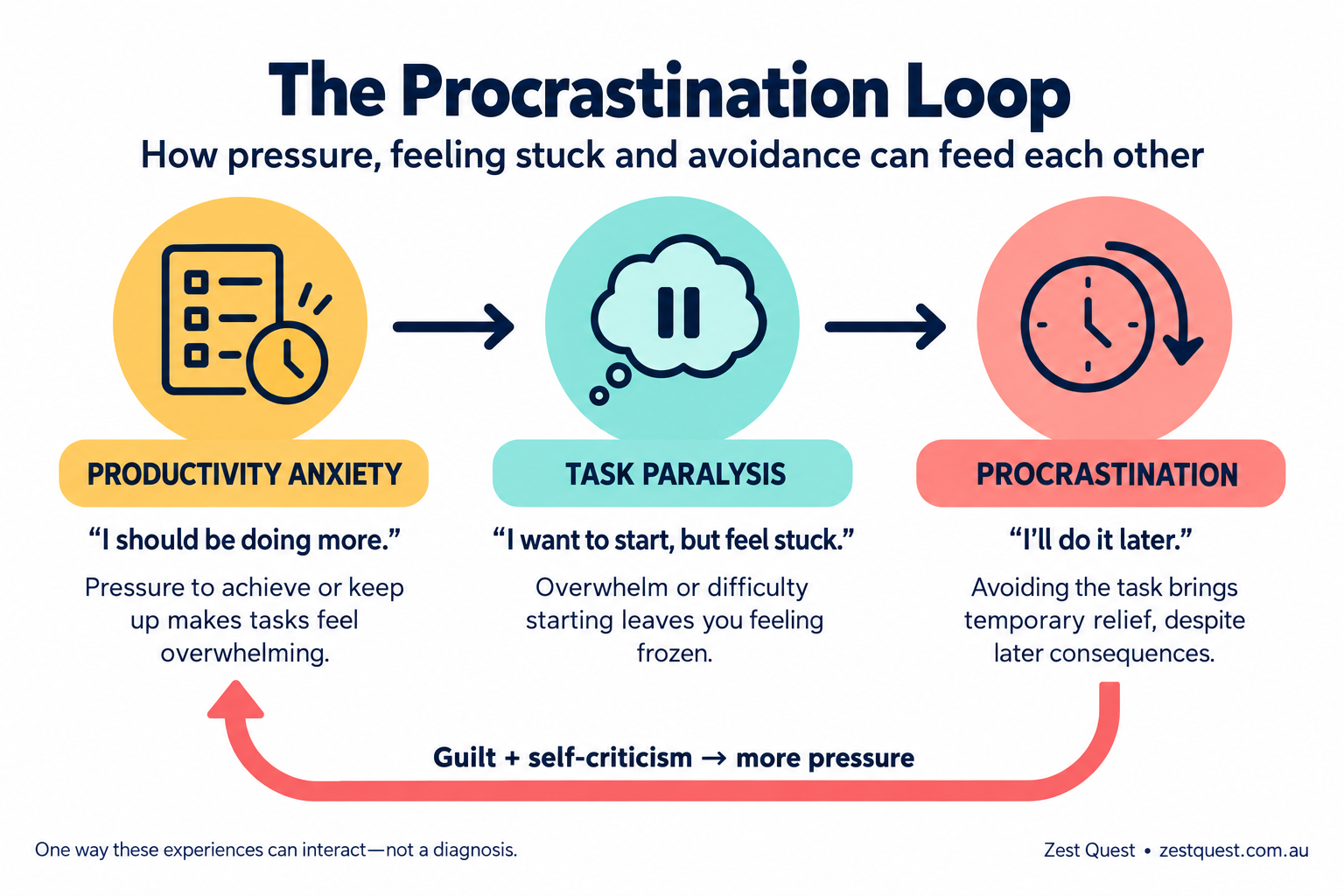
I use this loop to understand a common pattern. It isn't a diagnosis, and not everyone moves through it in the same order. You might notice the avoidance first, or the guilt that comes after. What matters is seeing how one part can strengthen the next.
For Brad, each unfinished weekend adds weight to the one after it. He now faces the same jobs with a backlog of disappointment attached.
Why avoiding something feels good ... for a while
Researchers Fuschia Sirois and Timothy Pychyl have studied procrastination closely. Their work shows that putting things off often puts feeling better right now ahead of our longer-term interests.[2] If thinking about a task stirs up discomfort, switching to something else brings quick relief.

So you scroll, make a coffee or tidy a drawer while the important job waits. The distraction gives you a short break from whatever the task brings up. That might be doubt, frustration or a fear of getting it wrong.
Sadly, the relief doesn't finish the job. When the task comes back to mind, the first discomfort often has guilt attached. Next time you think about starting, you're facing the task and your disappointment in yourself.
This helps explain why caring about something doesn't make it easier to do. A task that matters deeply can carry far more emotional weight than one you barely care about.
When high standards make starting harder
Perfectionism can add another layer. Wanting to do a job well makes sense. Needing to feel completely ready before you begin can leave you planning forever.
You research the right method, compare options and decide you need one more piece of information. It feels productive, yet the task sits untouched. Sometimes preparing is necessary. At other times it becomes a comfortable place to hide when taking action feels risky.
For Brad, even a family outing can pick up unrealistic expectations. Instead of choosing something simple, he feels he should plan a memorable day that everyone loves. What began as a chance to connect starts to feel like a test of whether he's a good father and husband.
I see this often. The more meaning you attach to getting something right, the harder an ordinary first step becomes.
Where ADHD fits in
ADHD can play a part in this loop. Adults with ADHD can find it hard to stay organised, keep their attention on a task and finish everyday jobs or bigger projects.[3] Difficulties getting started can leave tasks unfinished. That can then add pressure and self-criticism.
Feeling stuck doesn't mean you have ADHD, though. Overwhelm and anxiety can also make starting hard. So can exhaustion, or simply having too much on your plate, and sometimes you truly need rest or fewer demands.
Please note: If these struggles keep showing up and affect your daily life, a proper assessment can help make clear what support you need. Understanding your emotional patterns can sit alongside practical help and ADHD treatment where that's relevant. It doesn't explain away a neurodevelopmental condition, and I'd never suggest it does.
Why home can feel harder than work

Brad's story highlights how much the setting, or environment, matters. At work, someone else helps set priorities and deadlines. At home, he has to decide what matters, make a plan and get himself moving, often after a demanding week.
He may also carry expectations nobody has actually placed on him. Every unfinished repair becomes proof he's falling short. Missed family time adds a more personal sting.
Naming those pressures opens up better questions. Is he exhausted? Is the next step unclear? Is he trying to do too much? Or has an ordinary task become tangled up with what he believes it says about him?
Each answer points to further understanding himself and his patterns and what support could benefit him. Calling himself lazy gives him almost nothing to work with.
Three simple ways to get moving
Practical strategies have their place, although may not be enough on their own. Here are three simple strategies I often suggest to clients.
Take an embarrassingly small step. Open a new document and type the title. Put on your gym clothes, but don’t go to the gym. Make the first step so small it feels almost silly.
Change your surroundings. Go for a walk, move to another room or switch to a different task for a few minutes. A new setting can loosen the stuck feeling.
Try body doubling. This means having another person nearby while you work, even if they're not helping directly. Their company alone can make action easier.
For Brad, that might mean a short trip to the park instead of a big family day. It could mean checking the repair job and carrying his toolbox to the spot. Or he could ask his wife to keep him company while he makes a start.
Looking beneath the behaviour
If you keep coming back to the same pattern, it's worth looking at what happens inside you while you're in the loop. What are you feeling? What are you telling yourself? What are you afraid of getting wrong? And what relief does avoiding it bring?
At Zest Quest, I'm interested in those deeper patterns. That includes the beliefs and automatic responses that often run outside your conscious awareness. For some people, earlier experiences of criticism or pressure play a part. For others, the main issue right now is overload or a lack of support.
My aim is to help you respond from a place of strength, so you can bounce back, take action and feel more fulfilled. When a pattern runs deep, it's hard to shift on your own for more than short stretches. That's where working together can help.
Try my Procrastination Pattern Check
This is a simple observe and reflect exercise, not a diagnostic test. Pick one thing you're putting off. Spend two or three minutes noticing how you respond to it. Is there pressure to do it perfectly or to catch up? Do you feel overwhelmed when you picture starting? What do you do instead, and how do you speak to yourself afterwards?
Write down what you notice. Then choose one small action that suits your situation, such as working out the first step, asking for help or making the plan simpler.
If the loop keeps showing up
If the Procrastination Loop is a regular visitor, you've probably noticed it touching your home life, work, relationships and plain enjoyment of life. If you’re not sure what to do next, or you’ve tried before and nothing sticks, then there’s likely something deeper to consider. Then, I'd like to invite you to look at what’s underneath with me supporting you.
Understanding what happens between intention and action gives us a clear starting point for change. It can also help you make more room for the life you want to live.
You aren't broken, and you aren't lazy. Your brain is trying to protect you from stress in the only way it knows.
Be kind to yourself and shrink the steps. Action usually comes before motivation, not after it.
If you'd like to understand your pattern better and see whether support would help, book a free 45 minute call with me. Click here to schedule
Less stress, more zest,
Nicholas Dob


